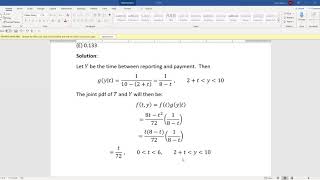
Media Summary: The elapsed time, T, between the occurrence and the reporting of an accident has probability density function f(t)=(8t-t^2)/72 for t ... Actuarial SOA Exam P Sample Question 204 (once 266) Solution Formerly SOA P Sample Question 204 (This Question has now been deleted by SOA)
Soa Exam P Question 204 Transformation - Detailed Analysis & Overview
The elapsed time, T, between the occurrence and the reporting of an accident has probability density function f(t)=(8t-t^2)/72 for t ... Actuarial SOA Exam P Sample Question 204 (once 266) Solution Formerly SOA P Sample Question 204 (This Question has now been deleted by SOA) The time until failure, T, of a product is modeled by a uniform distribution on [0, 10]. An extended warranty pays a benefit of 100 if ... An insurance company categorizes its policyholders into three mutually exclusive groups: high-risk, medium-risk, and low-risk. A policyholder purchases automobile insurance for two years. Define the following events: F = the policyholder has exactly one ...
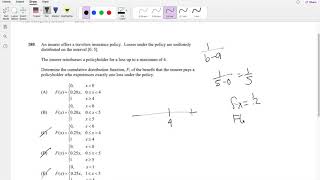
Actuarial SOA Exam P Sample Question 154 (once 208) Solution A machine has two components and fails when both components fail. The number of years from now until the first component fails, ... The time, T, that a manufacturing system is out of operation has cumulative distribution function F(t)=1-(2/t)^2 for t greater than 2 ... The joint probability density for X and Y is f(x,y)=2e^-(x+2y) Calculate the variance of Y given that X greater than 3 and Y greater ... An insurer offers a travelers insurance policy. Losses under the policy are uniformly distributed on the interval [0, 5]. The insurer ... A policyholder has probability 0.7 of having no claims, 0.2 of having exactly one claim, and 0.1 of having exactly two claims.
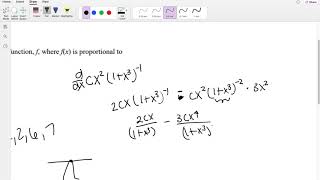
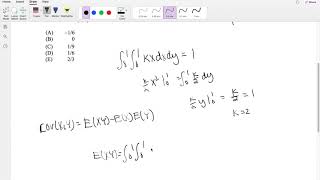
Actuarial SOA Exam P Sample Question 155 (once 209) Solution The lifetime of a light bulb has density function, f, where f(x) is proportional to x^3/(1+x^3) for x between 0 and 5 Calculate the ... A joint density function is given by f(x,y)=kx and x,yE[0,1] Calculate Cov(X,Y). (A) –1/6 (B) 0 (C) 1/9 (D) 1/6 (E) 2/3 You can find the ...