Media Summary: We continue our discussion on basis vectors, and explain the Gram-Schmidt procedure. For more information about Professor Shankar's book based on the (October 14, 2013) Building on the previous discussion of atomic energy levels, Leonard Susskind demonstrates the origin of the ...

Ph 503 Quantum Mechanics I Lecture 4 - Detailed Analysis & Overview

We continue our discussion on basis vectors, and explain the Gram-Schmidt procedure. For more information about Professor Shankar's book based on the (October 14, 2013) Building on the previous discussion of atomic energy levels, Leonard Susskind demonstrates the origin of the ... ... bar over 2 so this product has a factor of i h bar square over We continue our discussion of LVS introducing basis vectors. We then discuss the need for a dual vector space. (October 26, 2009) Leonard Susskind gives the fourth

We discuss the eigenfunctions of the X and P operators. ... question is we wrote down the schrodinger equation as the final postulate of We discuss matrices and basis change and introduce the notion of operators in QM. We discuss the spherical harmonics and write down the form of the first few of them. (April 23, 2013) Leonard Susskind completes the derivation of the Boltzman distribution of states of a system. This distribution ... We discuss sequential Stern-Gerlach experiments, demonstrating how the classical way of viewing the subatomic world is flawed.

We discuss the 1-D scattering problem in QM. We continue our discussion on the harmonic oscillator stressing the importance of the commutation relations. We also briefly ...
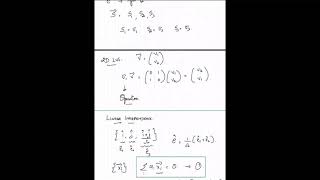
Photo Gallery

PH 503: Quantum Mechanics I. Lecture 4
PH 503: Quantum Mechanics I. Tutorial 4.
22. Quantum mechanics IV: Measurement theory, states of definite energy
Advanced Quantum Mechanics Lecture 4
Lecture 4: Expectations, Momentum, and Uncertainty
Lecture 4 | Modern Physics: Quantum Mechanics (Stanford)
Ph 503: Quantum Mechanics I. Tutorial 3.
PH 503: Quantum Mechanics I. Lecture 3
Lecture 4 | New Revolutions in Particle Physics: Basic Concepts
PH 503: Quantum Mechanics I. Lecture 14.
PH 503: Quantum Mechanics I. Tutorial 5.
PH 503: Quantum Mechanics I. Lecture 9.
View Detailed Profile
PH 503: Quantum Mechanics I. Lecture 4

PH 503: Quantum Mechanics I. Lecture 4

We continue our discussion on basis vectors, and explain the Gram-Schmidt procedure.

PH 503: Quantum Mechanics I. Tutorial 4.

PH 503: Quantum Mechanics I. Tutorial 4.

Okay now the postulates of

22. Quantum mechanics IV: Measurement theory, states of definite energy

22. Quantum mechanics IV: Measurement theory, states of definite energy

For more information about Professor Shankar's book based on the

Advanced Quantum Mechanics Lecture 4

Advanced Quantum Mechanics Lecture 4

(October 14, 2013) Building on the previous discussion of atomic energy levels, Leonard Susskind demonstrates the origin of the ...

Lecture 4: Expectations, Momentum, and Uncertainty

Lecture 4: Expectations, Momentum, and Uncertainty

MIT 8.04

Lecture 4 | Modern Physics: Quantum Mechanics (Stanford)

Lecture 4 | Modern Physics: Quantum Mechanics (Stanford)

Lecture 4

Ph 503: Quantum Mechanics I. Tutorial 3.

Ph 503: Quantum Mechanics I. Tutorial 3.

... bar over 2 so this product has a factor of i h bar square over

PH 503: Quantum Mechanics I. Lecture 3

PH 503: Quantum Mechanics I. Lecture 3

We continue our discussion of LVS introducing basis vectors. We then discuss the need for a dual vector space.

Lecture 4 | New Revolutions in Particle Physics: Basic Concepts

Lecture 4 | New Revolutions in Particle Physics: Basic Concepts

(October 26, 2009) Leonard Susskind gives the fourth

PH 503: Quantum Mechanics I. Lecture 14.

PH 503: Quantum Mechanics I. Lecture 14.

We discuss the eigenfunctions of the X and P operators.

PH 503: Quantum Mechanics I. Tutorial 5.

PH 503: Quantum Mechanics I. Tutorial 5.

... question is we wrote down the schrodinger equation as the final postulate of

PH 503: Quantum Mechanics I. Lecture 9.

PH 503: Quantum Mechanics I. Lecture 9.

We begin discussing the postulates of

PH 503: Quantum Mechanics I. Lecture 5

PH 503: Quantum Mechanics I. Lecture 5

We discuss matrices and basis change and introduce the notion of operators in QM.

PH 503: Quantum Mechanics I. Lecture 29.

PH 503: Quantum Mechanics I. Lecture 29.

We discuss the spherical harmonics and write down the form of the first few of them.

Statistical Mechanics Lecture 4

Statistical Mechanics Lecture 4

(April 23, 2013) Leonard Susskind completes the derivation of the Boltzman distribution of states of a system. This distribution ...

4 . Density Matrix 1

4 . Density Matrix 1

Quantum

PH 503: Quantum Mechanics I. Lecture 1

PH 503: Quantum Mechanics I. Lecture 1

We discuss sequential Stern-Gerlach experiments, demonstrating how the classical way of viewing the subatomic world is flawed.

PH 503: Quantum Mechanics I. Lecture 25.

PH 503: Quantum Mechanics I. Lecture 25.

We discuss the 1-D scattering problem in QM.

PH 503: Quantum Mechanics I. Lecture 22.

PH 503: Quantum Mechanics I. Lecture 22.

We continue our discussion on the harmonic oscillator stressing the importance of the commutation relations. We also briefly ...