Media Summary: By Ke Li (Caltech) Abstract: Suppose we are given n copies of one of the QIP 2016, Banff, 10-16 January 2016 Date: 12 Jan 2016 Title: " QIP 2016, Banff, 10-16 January 2016 Date: 12 Jan 2016, 10-16 January 2016 Title: "

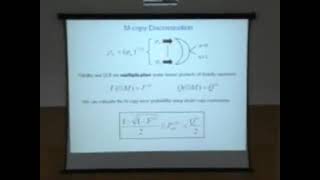
Discriminating Quantum States The Multiple Chernoff Distance - Detailed Analysis & Overview

By Ke Li (Caltech) Abstract: Suppose we are given n copies of one of the QIP 2016, Banff, 10-16 January 2016 Date: 12 Jan 2016 Title: " QIP 2016, Banff, 10-16 January 2016 Date: 12 Jan 2016, 10-16 January 2016 Title: " An information-geometric characterization of Talk presented by P.W. Lamberti at the X Conference on Abstract: The Holevo-Helstrom theorem places a bound on the probability of perfectly distinguishing two non-orthogonal

2020 IEEE International Symposium on Information Theory 21-26 June 2020 Los Angeles, California, USA Q.4: Nilin Abrahamsen (Simons Institute) Meet the Fellows Welcome Event. This uh this talk by is when do loc suffice for optimal Speaker : Eeshan Modak Affiliation : TIFR Abstract : We study the MIT 18.200 Principles of Discrete Applied Mathematics, Spring 2024 Instructor: Ankur Moitra View the complete course: ... Bhy Stephan Weis (Université libre de Bruxelles) Abstract: A convex set C is stable if the midpoint map (x,y) - (x+y)/2 is open.

This video is a summary of important formulas and the inequalities of trace By Nilanjana Datta (Cambridge University) Abstract:
Photo Gallery

Discriminating quantum states: the multiple Chernoff distance
Jan 12 Ke Li."Discriminating quantum states: the multiple Chernoff distance" (Part 1)
Jan 12 Ke Li."Discriminating quantum states: the multiple Chernoff distance" (Part 2)
Chernoff point   (Chernoff information)
P.W. Lamberti: A Procustes's Approach to Distances Between Quantum States
On the error exponents of binary quantum state discrimination with composite hypotheses
Christopher Vairogs: Quantum state discrimination circuits inspired by Deutschian CTCs
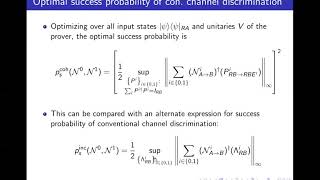
Coherent Quantum Channel Discrimination - Mark Wilde
Quantum state discrimination with continuous variables_62 Dr Stefano Pirandola
What is the Chernoff Bound?
Short Proof of a Spectral Chernoff Bound for Local Hamiltonians
007 When do LOCC suffice for optimal quantum state discrimination?
View Detailed Profile
Discriminating quantum states: the multiple Chernoff distance

Discriminating quantum states: the multiple Chernoff distance

By Ke Li (Caltech) Abstract: Suppose we are given n copies of one of the

Jan 12 Ke Li."Discriminating quantum states: the multiple Chernoff distance" (Part 1)

Jan 12 Ke Li."Discriminating quantum states: the multiple Chernoff distance" (Part 1)

QIP 2016, Banff, 10-16 January 2016 Date: 12 Jan 2016 Title: "

Jan 12 Ke Li."Discriminating quantum states: the multiple Chernoff distance" (Part 2)

Jan 12 Ke Li."Discriminating quantum states: the multiple Chernoff distance" (Part 2)

QIP 2016, Banff, 10-16 January 2016 Date: 12 Jan 2016, 10-16 January 2016 Title: "

Chernoff point   (Chernoff information)

Chernoff point (Chernoff information)

An information-geometric characterization of

P.W. Lamberti: A Procustes's Approach to Distances Between Quantum States

P.W. Lamberti: A Procustes's Approach to Distances Between Quantum States

Talk presented by P.W. Lamberti at the X Conference on

On the error exponents of binary quantum state discrimination with composite hypotheses

On the error exponents of binary quantum state discrimination with composite hypotheses

On the error exponents of binary

Christopher Vairogs: Quantum state discrimination circuits inspired by Deutschian CTCs

Christopher Vairogs: Quantum state discrimination circuits inspired by Deutschian CTCs

Abstract: The Holevo-Helstrom theorem places a bound on the probability of perfectly distinguishing two non-orthogonal

Coherent Quantum Channel Discrimination - Mark Wilde

Coherent Quantum Channel Discrimination - Mark Wilde

2020 IEEE International Symposium on Information Theory 21-26 June 2020 • Los Angeles, California, USA Q.4:

Quantum state discrimination with continuous variables_62 Dr Stefano Pirandola

Quantum state discrimination with continuous variables_62 Dr Stefano Pirandola

Project Name:

What is the Chernoff Bound?

What is the Chernoff Bound?

Explains the

Short Proof of a Spectral Chernoff Bound for Local Hamiltonians

Short Proof of a Spectral Chernoff Bound for Local Hamiltonians

Nilin Abrahamsen (Simons Institute) Meet the Fellows Welcome Event.

007 When do LOCC suffice for optimal quantum state discrimination?

007 When do LOCC suffice for optimal quantum state discrimination?

This uh this talk by is when do loc suffice for optimal

Why does quantum allow superpositions?

Why does quantum allow superpositions?

Another in depth look at

Nilanjana Datta | Sept 8, 2020 | Discriminating between unitary quantum processes

Nilanjana Datta | Sept 8, 2020 | Discriminating between unitary quantum processes

Speaker: Nilanjana Datta Title:

Hypothesis Testing for Adversarial Channels: Chernoff-Stein Exponents

Hypothesis Testing for Adversarial Channels: Chernoff-Stein Exponents

Speaker : Eeshan Modak Affiliation : TIFR Abstract : We study the

Quantum state discrimination with continuous variables 62 Dr Stefano Pirandola

Quantum state discrimination with continuous variables 62 Dr Stefano Pirandola

Course :

Lecture 9: Chernoff Bounds

Lecture 9: Chernoff Bounds

MIT 18.200 Principles of Discrete Applied Mathematics, Spring 2024 Instructor: Ankur Moitra View the complete course: ...

Stability of the set of quantum states

Stability of the set of quantum states

Bhy Stephan Weis (Université libre de Bruxelles) Abstract: A convex set C is stable if the midpoint map (x,y) - (x+y)/2 is open.

quantum information theory---29 [Trace distance and fidelity (important inequalities!!) ]

quantum information theory---29 [Trace distance and fidelity (important inequalities!!) ]

This video is a summary of important formulas and the inequalities of trace

Concentration of quantum states from quantum functional and transportation cost inequalities

Concentration of quantum states from quantum functional and transportation cost inequalities

By Nilanjana Datta (Cambridge University) Abstract: