Media Summary: This lesson explores the BULK COLLECT feature, which allows you to retrieve multiple rows of In this Video Tutorial, I have covered 2 great feature in Oracle This lesson demonstrates the steps needed to convert from "legacy" code that still relies on row-by-row fetching of

Blk3 Change Data Faster With Forall Pl Sql Channel - Detailed Analysis & Overview

This lesson explores the BULK COLLECT feature, which allows you to retrieve multiple rows of In this Video Tutorial, I have covered 2 great feature in Oracle This lesson demonstrates the steps needed to convert from "legacy" code that still relies on row-by-row fetching of The first lesson in the bulk processing series, this video discusses why bulk processing is needed to improve "Row by row = slow by slow" - one of Tom Kyte's more famous and catchy memes. Row by row processing of When you don't know the number of columns you are selecting or the number of placeholders that need binding, you are facedĀ ...

Photo Gallery

BLK3: Change Data Faster with FORALL (PL/SQL Channel)
BLK2: Get Data Faster with BULK COLLECT (PL/SQL Channel)
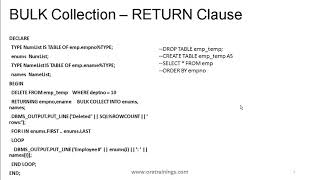
PL/SQL Tutorial : Using RETURNING  INTO Clause  in FORALL
BULK COLLECT and FORALL-A PL/SQL Performance Booster
Oracle PL SQL interview question | Oracle FOR vs FORALL | Oracle FORALL advantages and limitations
PL/SQL Tutorial : FORALL with SAVE EXCEPTION
Oracle PLSQL - BULK Extract, Insert, Update and Delete
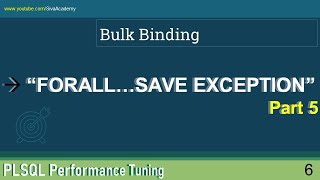
6 PLSQL Performance Tuning | Oracle FORALL | Oracle FORALL SAVE EXCEPTIONS | Part5
BLK4: Converting from Row-by-Row to Bulk Processing (PL/SQL Channel)
Beyond the Basics with FORALL
5 PLSQL Performance Tuning | Oracle Bulk Collect | oracle FORALL bulk collect | Part4
Update a Table with Millions of Rows in SQL (Fast)
View Detailed Profile
BLK3: Change Data Faster with FORALL (PL/SQL Channel)

BLK3: Change Data Faster with FORALL (PL/SQL Channel)

This lesson explores the amazing

BLK2: Get Data Faster with BULK COLLECT (PL/SQL Channel)

BLK2: Get Data Faster with BULK COLLECT (PL/SQL Channel)

This lesson explores the BULK COLLECT feature, which allows you to retrieve multiple rows of

PL/SQL Tutorial : Using RETURNING  INTO Clause  in FORALL

PL/SQL Tutorial : Using RETURNING INTO Clause in FORALL

PL

BULK COLLECT and FORALL-A PL/SQL Performance Booster

BULK COLLECT and FORALL-A PL/SQL Performance Booster

In this Video Tutorial, I have covered 2 great feature in Oracle

Oracle PL SQL interview question | Oracle FOR vs FORALL | Oracle FORALL advantages and limitations

Oracle PL SQL interview question | Oracle FOR vs FORALL | Oracle FORALL advantages and limitations

Oracle

PL/SQL Tutorial : FORALL with SAVE EXCEPTION

PL/SQL Tutorial : FORALL with SAVE EXCEPTION

PL

Oracle PLSQL - BULK Extract, Insert, Update and Delete

Oracle PLSQL - BULK Extract, Insert, Update and Delete

Oracle

6 PLSQL Performance Tuning | Oracle FORALL | Oracle FORALL SAVE EXCEPTIONS | Part5

6 PLSQL Performance Tuning | Oracle FORALL | Oracle FORALL SAVE EXCEPTIONS | Part5

6

BLK4: Converting from Row-by-Row to Bulk Processing (PL/SQL Channel)

BLK4: Converting from Row-by-Row to Bulk Processing (PL/SQL Channel)

This lesson demonstrates the steps needed to convert from "legacy" code that still relies on row-by-row fetching of

Beyond the Basics with FORALL

Beyond the Basics with FORALL

The

5 PLSQL Performance Tuning | Oracle Bulk Collect | oracle FORALL bulk collect | Part4

5 PLSQL Performance Tuning | Oracle Bulk Collect | oracle FORALL bulk collect | Part4

Oracle

Update a Table with Millions of Rows in SQL (Fast)

Update a Table with Millions of Rows in SQL (Fast)

Get my free

BLK1: Introduction to Bulk Processing (PL/SQL Channel)

BLK1: Introduction to Bulk Processing (PL/SQL Channel)

The first lesson in the bulk processing series, this video discusses why bulk processing is needed to improve

Bulk Processing in PL/SQL

Bulk Processing in PL/SQL

"Row by row = slow by slow" - one of Tom Kyte's more famous and catchy memes. Row by row processing of

DYN6: Method 4 dynamic SQL with DBMS_SQL (PL/SQL Channel)

DYN6: Method 4 dynamic SQL with DBMS_SQL (PL/SQL Channel)

When you don't know the number of columns you are selecting or the number of placeholders that need binding, you are facedĀ ...